Localization and Contextualization of AI in Healthcare
Domain-Aware Self-Supervised Learning for Cell-Level Malaria Classification
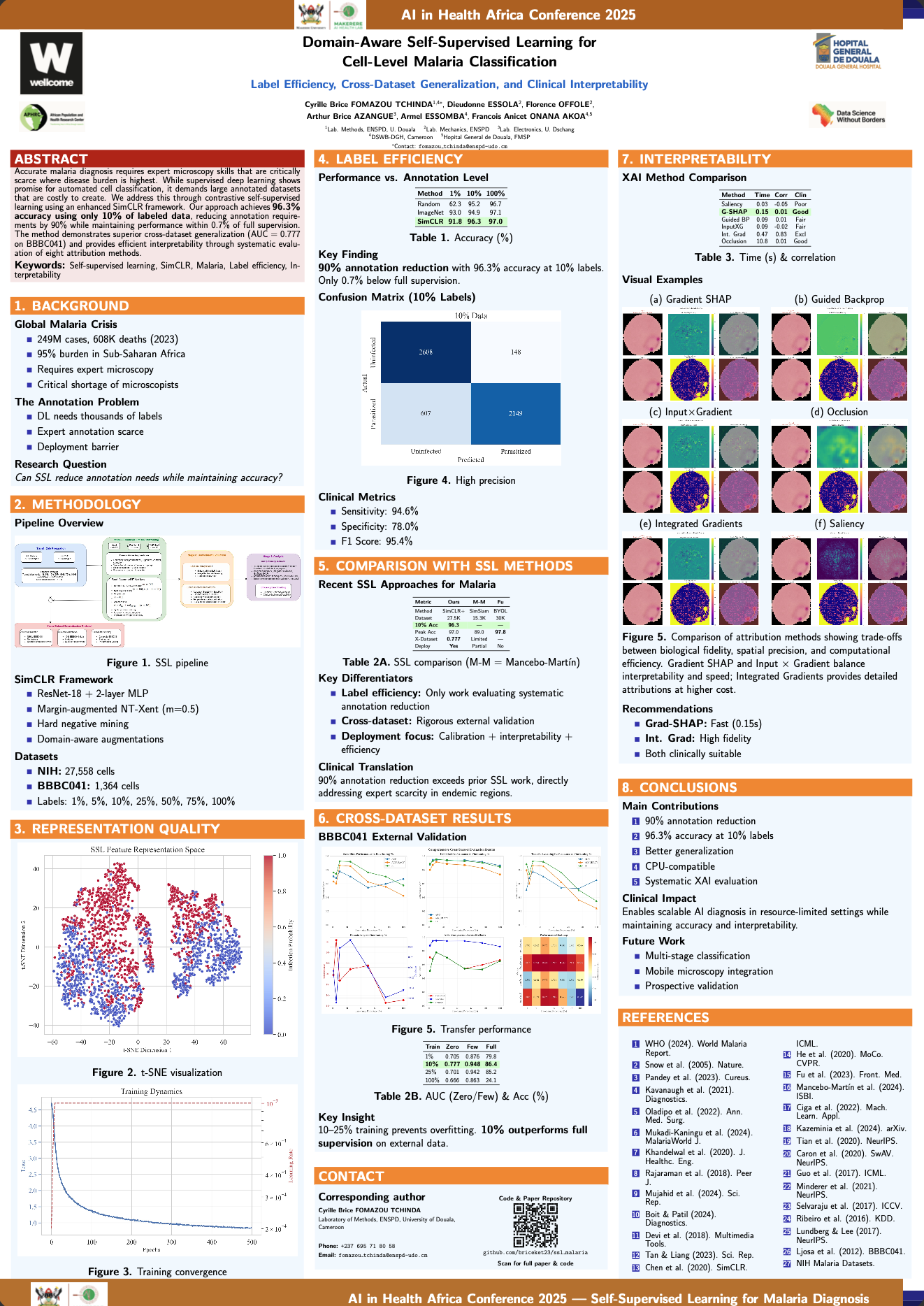
Accurate malaria diagnosis requires expert microscopy skills that are critically
scarce where disease burden is highest. While supervised deep learning shows
promise for automated cell classification, it demands large annotated datasets
that are costly to create. We address this through contrastive self-supervised
learning using an enhanced SimCLR framework. Our approach achieves 96.3%
accuracy using only 10% of labeled data, reducing annotation require-
ments by 90% while maintaining performance within 0.7% of full supervision.
The method demonstrates superior cross-dataset generalization (AUC = 0.777
on BBBC041) and provides efficient interpretability through systematic evalu-
ation of eight attribution methods.
Keywords: Self-supervised learning, SimCLR, Malaria, Label efficiency, In-
terpretability
scarce where disease burden is highest. While supervised deep learning shows
promise for automated cell classification, it demands large annotated datasets
that are costly to create. We address this through contrastive self-supervised
learning using an enhanced SimCLR framework. Our approach achieves 96.3%
accuracy using only 10% of labeled data, reducing annotation require-
ments by 90% while maintaining performance within 0.7% of full supervision.
The method demonstrates superior cross-dataset generalization (AUC = 0.777
on BBBC041) and provides efficient interpretability through systematic evalu-
ation of eight attribution methods.
Keywords: Self-supervised learning, SimCLR, Malaria, Label efficiency, In-
terpretability
BACKGROUND:
Global Malaria Crisis
- 249M cases, 608K deaths (2023)
- 95% burden in Sub-Saharan Africa
- Requires expert microscopy
- Critical shortage of microscopists
The Annotation Problem
- DL needs thousands of labels
- Expert annotation scarce
- Deployment barrier
Research Question
Can SSL reduce annotation needs while maintaining accuracy?
Keywords: Localization and Contextualization of AI in Healthcare
Download or View PDF
Share
Gallery