AI Policy and Ethics in Healthcare
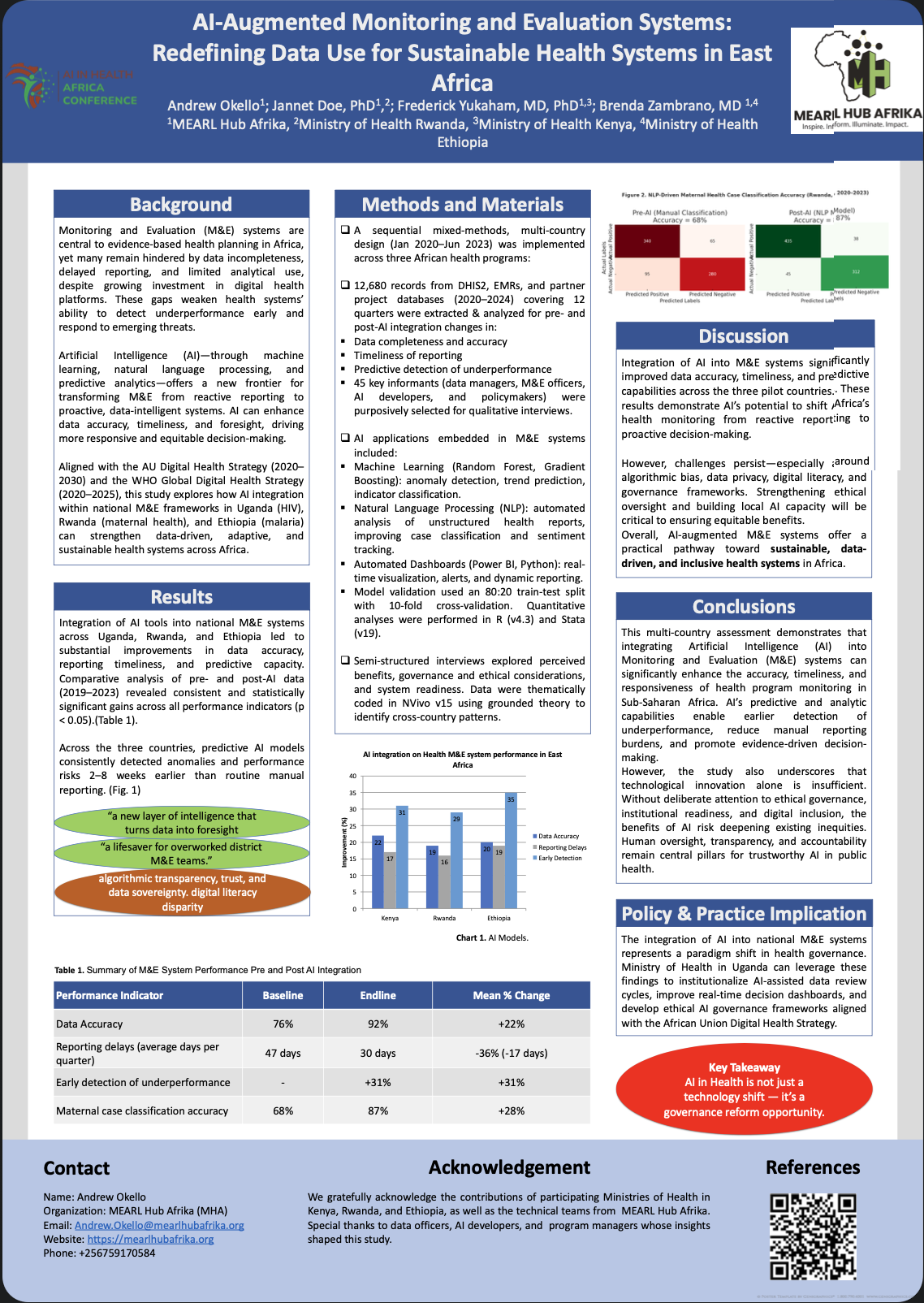
AI-Augmented Monitoring and Evaluation Systems: Redefining Data Use for Sustainable Health Systems in East Africa
Background:
Monitoring and Evaluation (M&E) systems are central to evidence-based health planning in Africa, yet many remain hindered by data incompleteness, delayed reporting, and limited analytical use, despite growing investment in digital health platforms. These gaps weaken health systems’ ability to detect underperformance early and respond to emerging threats. Artificial Intelligence (AI)—through machine learning, natural language processing, and predictive analytics—offers a new frontier for transforming M&E from reactive reporting to proactive, data-intelligent systems. AI can enhance data accuracy, timeliness, and foresight, driving more responsive and equitable decision-making. Aligned with the AU Digital Health Strategy (2020–2030) and the WHO Global Digital Health Strategy (2020–2025), this study explores how AI integration within national M&E frameworks in Uganda (HIV), Rwanda (maternal health), and Ethiopia (malaria) can strengthen data-driven, adaptive, and sustainable health systems across Africa.
Monitoring and Evaluation (M&E) systems are central to evidence-based health planning in Africa, yet many remain hindered by data incompleteness, delayed reporting, and limited analytical use, despite growing investment in digital health platforms. These gaps weaken health systems’ ability to detect underperformance early and respond to emerging threats. Artificial Intelligence (AI)—through machine learning, natural language processing, and predictive analytics—offers a new frontier for transforming M&E from reactive reporting to proactive, data-intelligent systems. AI can enhance data accuracy, timeliness, and foresight, driving more responsive and equitable decision-making. Aligned with the AU Digital Health Strategy (2020–2030) and the WHO Global Digital Health Strategy (2020–2025), this study explores how AI integration within national M&E frameworks in Uganda (HIV), Rwanda (maternal health), and Ethiopia (malaria) can strengthen data-driven, adaptive, and sustainable health systems across Africa.
Keywords: AI Policy and Ethics in Healthcare
Gallery